Vacuum Sealing Baby Food: Prepare, Portion and Freeze Homemade Purées
Vacuum sealing homemade baby food, freezing it in portions and storing it safely: practical meal-prep tips for parents – with the most important food-safety notes for babies.
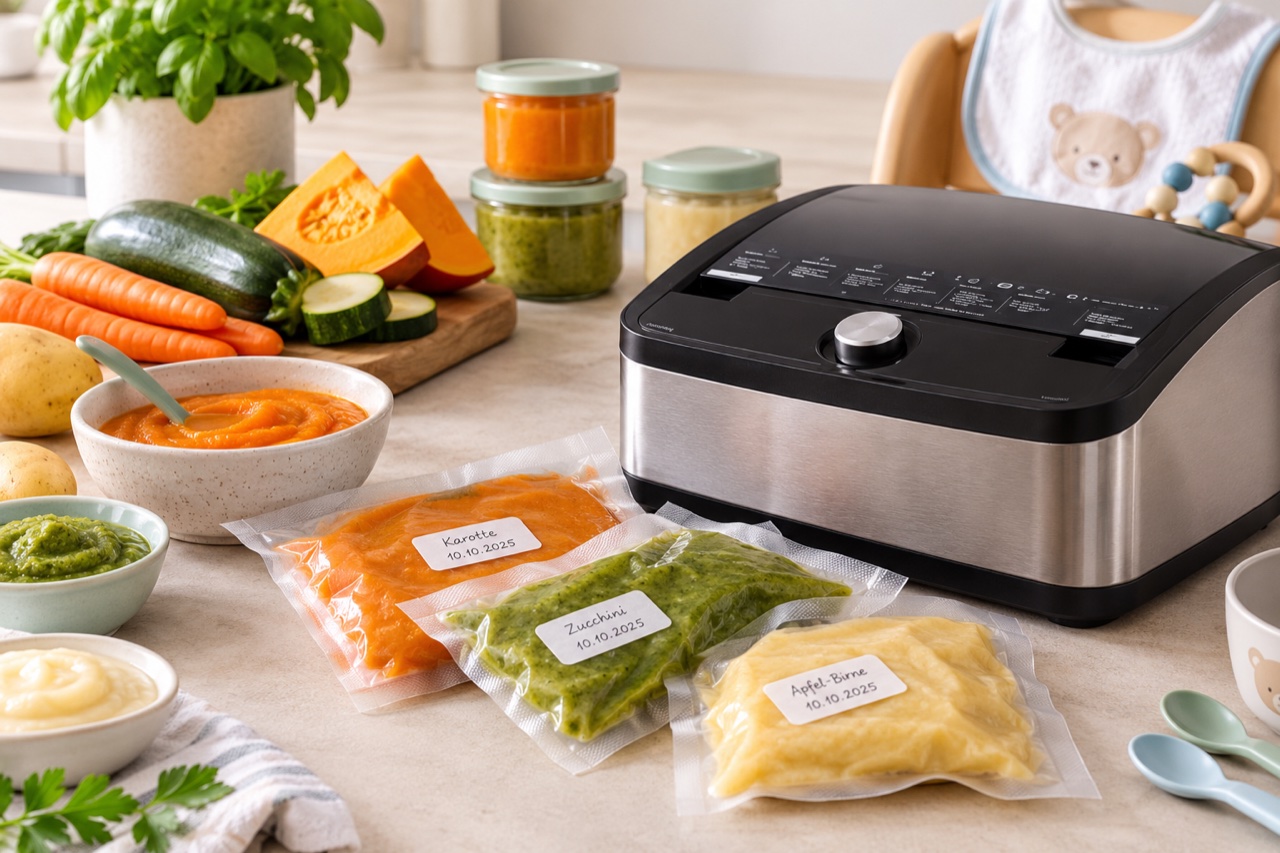
Homemade baby food is fresh, free of unnecessary salt or sugar – and with a little preparation it can easily be cooked in advance. Anyone who prepares several portions at once saves a lot of time on hectic days. Vacuum sealing baby food can help to pack portions neatly, freeze them in a space-saving way and keep track of everything.
In this guide we show you how to prepare baby food in larger quantities, portion it with vacuum bags and freeze it safely. One thing up front: vacuum sealing keeps food neatly packed and space-saving – but it replaces neither refrigerating nor freezing and does not make baby food shelf-stable at room temperature.
Why prepare homemade baby food?
For many parents, home-cooked complementary food has clear advantages:
- Ingredients under control: you decide what goes into the purée and can avoid added salt and sugar.
- Freshness and variety: seasonal vegetables and fruit can be combined in an age-appropriate way.
- Less packaging waste and cost: cooking larger amounts yourself is often cheaper than ready-made jars.
- Encouraging habits: your child gets to know different flavours early on.
When and how to start complementary feeding is best discussed based on paediatric recommendations – every child develops individually.
Which foods are suitable for homemade baby food?
Vegetables
Mild, soft-cooked vegetables such as carrots, pumpkin, sweet potatoes and zucchini are well suited. They purée finely and are popular with many babies.
Fruit
Fruit purées of apple and pear are good as a first fruit food. Gently steam ripe fruit and then purée it finely.
Age-appropriate combinations
As your child grows, purées can be supplemented with filling components such as potatoes, rice or other suitable grains. For ingredients, consistency and the introduction of allergens, follow current complementary-feeding recommendations (see sources at the end).
Preparing baby food step by step
Here's how to prepare several portions at once:
- Wash and peel: wash vegetables and fruit thoroughly and – where useful – peel them.
- Cook until soft: steam or simmer in a little water until everything is very soft. Steaming preserves more nutrients.
- Purée or mash: bring to an age-appropriate consistency – finely puréed at first, coarser later.
- Cool quickly: let the purée cool rapidly after cooking, for example in shallow containers, and don't leave it standing at room temperature for long.
- Portion: divide the cooled purée into individual portions – so later only what is needed is thawed.
Vacuum sealing baby food: how it works with vacuum bags
For vacuum sealing you need a suitable vacuum sealer – for example a stainless-steel countertop machine – and matching, food-safe vacuum bags. Here's how:
- Cool first, then fill: only fill in fully cooled purée. Warm food does not belong in the bag, as it would otherwise delay cooling.
- Leave room for sealing: leave enough space at the top so the seam closes cleanly.
- Keep the sealing area clean: the bag edge must be dry and free of food residue – otherwise the seam won't hold reliably.
- Mind liquids: thin purées and liquids can be drawn into the machine. If available, use a suitable moist-food function or pulse mode, freeze the purée slightly beforehand, or use suitable containers.
- Follow the manufacturer's instructions: go by your device's manual and use only the bags intended for it.
Important: vacuum sealing is not cooking and not sterilization. It merely removes air from the bag and protects against freezer burn – it does not kill germs.
Freezing and storage
Vacuum-sealed portions freeze neatly and save space. Keep in mind:
- Freeze baby food in portions: individual portions freeze through faster and can be taken out as needed.
- Label: note the contents and preparation date on each bag.
- Thaw safely: thaw portions in the fridge, not at room temperature. Reheat thawed purée thoroughly before feeding, then let it cool to eating temperature.
- Don't refreeze: do not freeze thawed portions again.
As a rough guide, freshly prepared baby food usually keeps only about one to two days in the fridge and a few weeks to a few months in the freezer. Don't rely on blanket figures; follow official recommendations (see sources) and check appearance and smell. Vacuum sealing does not automatically extend these times and does not make baby food shelf-stable at room temperature.
A practical meal-prep workflow for parents
Here's how to prepare supplies for the week on a quiet day:
- Cook several types of vegetables or fruit soft at the same time.
- Purée separately and let cool quickly.
- Divide into child-friendly portions.
- Fill into vacuum bags, seal and label.
- Freeze flat – so the portions stack in a space-saving way.
On hectic days, simply take a portion from the freezer, thaw it in the fridge and warm it up fresh.
Vacuum bags or vacuum containers?
Both options have their strengths – which suits better depends on consistency and habits:
- Vacuum bags: space-saving in the freezer, easy to stack and ideal for flat-frozen portions. For very thin purées, however, caution is needed when vacuum sealing.
- Vacuum containers: reusable, sturdy and practical for runnier purées that would otherwise be drawn into the machine – but they take up more space.
So bags are not automatically the better choice. For many parents a combination makes sense: containers for liquid, bags for firmer purées.
Safety for babies
Careful hygiene is especially important with infants:
- Age-appropriate consistency: finely puréed at first, coarser later as development allows.
- Introduce allergens mindfully: follow current complementary-feeding recommendations and discuss uncertainties with your paediatrician.
- Work hygienically: keep hands, surfaces and devices clean; separate raw and cooked foods to avoid cross-contamination.
- Cook and cool safely: cook thoroughly and then cool quickly.
- No salt and sugar: avoid added salt and sugar.
- Discard leftovers after the meal: do not store purée your baby has already eaten from – saliva gets into the purée via the spoon and can promote bacterial growth. Always take out only as much as will be eaten.
Important: vacuum sealing is not preservation
This point is crucial: vacuum sealing alone does not sterilize, does not eliminate pathogens and does not make homemade baby food shelf-stable at room temperature. Removing air can also create a low-oxygen environment in which certain germs can multiply under unfavourable conditions. Vacuum sealing is therefore no substitute for proper refrigerating and freezing, but a practical addition for order and portioning.
FAQ – Common questions about vacuum sealing baby food
Can I vacuum seal baby food while warm?
No. Only fill in fully cooled purée. Vacuum sealing while warm delays cooling and is not advisable for safety reasons.
Can I store vacuum-sealed baby food without refrigeration?
No. Vacuum sealing does not make baby food shelf-stable at room temperature. Always keep portions in the fridge or freezer.
Can purées be vacuum sealed without liquid being drawn into the machine?
Thin purées can be drawn in. Use a suitable moist-food function or pulse mode, freeze the purée slightly beforehand, or use vacuum containers instead of bags.
Can I reuse vacuum bags?
Bags that have been in contact with raw or already-eaten food should not be reused for hygiene reasons. For baby food, a fresh bag or a cleanable vacuum container is preferable when in doubt.
Conclusion: more organisation with the right equipment
With a little preparation, homemade baby food can conveniently be cooked in advance, portioned and frozen. Vacuum sealing helps to pack portions neatly and save space – but it does not replace refrigerating or freezing and does not extend shelf life on its own.
If you regularly prepare complementary food, you will benefit from the right equipment: a reliable vacuum sealer and compatible, food-safe vacuum bags. In our shop you will find a suitable selection – as practical helpers for well-organised baby-food portions in everyday life.
Further sources
- Gesund ins Leben – Netzwerk Junge Familie (recommendations on complementary feeding and allergy prevention, in German)
- Bundeszentrum für Ernährung (BZfE) (German Federal Centre for Nutrition)
- Bundesinstitut für Risikobewertung (BfR) (food hygiene and safety, in German)
- kindergesundheit-info.de (BZgA)
For questions about your child's individual nutrition, please consult your paediatrician or a qualified nutrition professional.