How much does a family of four throw away – and how can a vacuum sealer help?
Food waste costs families a lot of money every year. With the right storage, smart portioning and a vacuum sealer, some of it can be avoided. We show the savings potential with concrete figures.
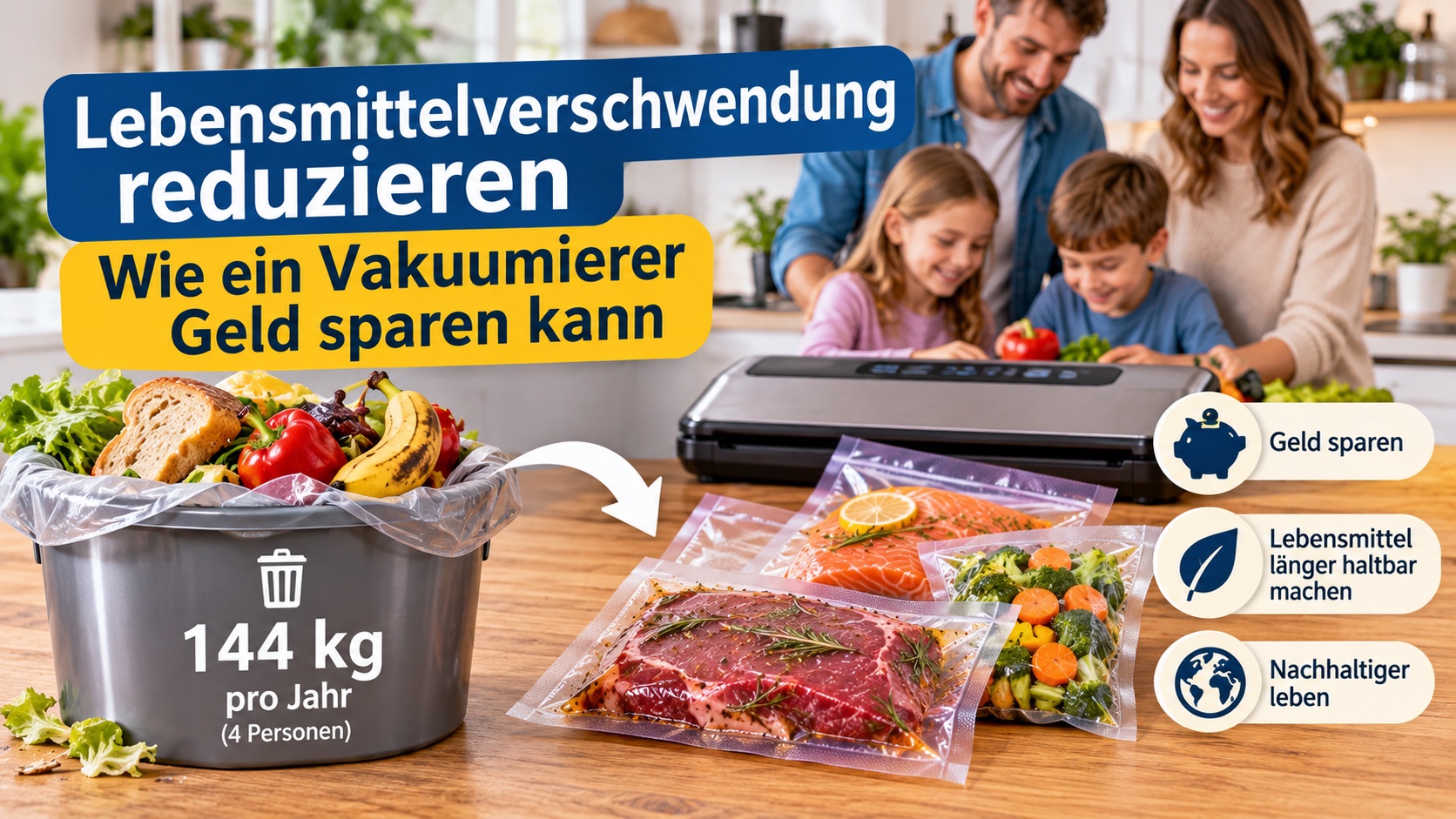
Food waste costs families a lot of money every year. But with the right storage, smart portioning and a vacuum sealer, some of it can be avoided. Using concrete figures, we show how much a family of four throws away and what savings potential lies in vacuum sealing.
1. How much food ends up in the bin each year?
Many families know the situation: you buy larger quantities of meat on offer, open a pack of cheese, cook too much for dinner or forget vegetables in the fridge. A few days later it all ends up in the bin. The problem is bigger than many think.
A study on food waste in Germany published in 2025 found, on average:
- 36 kg of avoidable food waste per person per year.
- An estimated financial loss of €149 per person per year.
Projecting this average onto a family of four gives the following order of magnitude:
- Food per year: 144 kg.
- Financial loss per year: €596.
- Food per month: 12 kg.
- Money lost per month: €49.67.
Important: this is a simple projection of the per-capita average, not a direct measurement of a four-person household. Larger households statistically tend to waste slightly less per person. Even so, it shows how much money can be lost in the kitchen.
2. Why do families throw away so much food?
There are various reasons why food isn't used in time. The most common everyday situations:
- Buying too much: meat, vegetables and more are often bought in large packs for bulk discounts – not all of it is used in time.
- Opened packaging: once opened, cheese, cold cuts, meat and other sensitive products lose quality faster and get forgotten.
- Wrong storage: air, moisture and temperature swings reduce quality.
- Portions too large: cooking leaves leftovers that get thrown out without proper storage.
- Freezer burn: food not protected from air dries out in the freezer and loses flavour and quality.
3. How can a vacuum sealer reduce food waste?
A vacuum sealer removes much of the air from a suitable pack and seals it airtight. This helps to avoid food waste and keep food fresh for longer.
Portion meat and fish
Instead of keeping a large opened pack of meat in the fridge, divide it into single meals right after shopping. Example: a family buys 2 kg of chicken breast and prepares four 500 g portions, sealed individually. That way you only defrost what you need.
Protect food longer in the freezer
Removing the air reduces contact with oxygen, helping to avoid freezer burn and better preserve the quality of frozen food – ideal for freezing.
Keep dinner leftovers
Cooked too much? Leftover meat, vegetables or other suitable dishes can be packed in portions and frozen.
Organise bigger shops better
Anyone who regularly buys larger quantities can sort, portion, label and freeze food right after shopping. This makes meal planning easier and reduces forgotten food.
4. A practical example: a week without food waste
Imagine a family of four that does a big shop once a week:
- Chicken breast – 2 kg → 4 portions of 500 g.
- Pork – 1.5 kg → 3 portions of 500 g.
- Minced meat – 1 kg → 2 portions of 500 g.
- Fish – 800 g → 2 portions of 400 g.
- Cheese – 1 kg → split into smaller amounts.
- Vegetables – as needed → prepare suitable amounts.
With a vacuum sealer, suitable food can be packed in portions right after shopping. The family no longer has to wonder whether an already-opened pack of meat will be used in time.
Note: perishable food must still be properly chilled or frozen. Vacuum sealing does not replace refrigeration.
5. How much money can a family really save?
Using the estimated €596 of avoidable food losses per year as a calculation basis, we can run through various saving scenarios. These are explicitly model calculations, not scientifically proven savings from a vacuum sealer:
- 5% less loss: 7.2 kg → approx. €29.80 saved per year.
- 10% less loss: 14.4 kg → approx. €59.60 per year.
- 15% less loss: 21.6 kg → approx. €89.40 per year.
- 20% less loss: 28.8 kg → approx. €119.20 per year.
Even a relatively small reduction adds up over time: if the family cuts 10% of its avoidable losses each year through better portioning and storage, that's nearly €60 less. Extra benefits from better shopping planning and fewer spontaneous purchases are not even included here.
6. When is buying a vacuum sealer worth it?
Whether a vacuum sealer for the household pays off financially depends on several factors:
- How often does the family buy larger quantities of food?
- How much meat, fish and vegetables get frozen?
- How often is there food left over?
- How much money is regularly lost to spoiled food?
- What are the purchase costs and the cost of bags or rolls?
A simple rule of thumb: annual saving − ongoing packaging cost = actual annual benefit. Example with an assumed saving of €60:
- Avoided food losses: +€60.
- Packaging material per year (example): −€20.
- Actual benefit: €40.
The purchase cost of the device comes on top. A vacuum sealer is especially worthwhile for families who regularly buy and freeze larger quantities of meat or other suitable food. By the way: whether vacuum rolls or pre-made bags make more sense is something we've worked out in a separate article.
7. Vacuum sealing alone isn't enough: the right habits
A vacuum sealer is a helpful tool, but not a miracle cure. A few simple rules help keep as little food as possible from being wasted:
- Plan your shopping and buy only what you need.
- Sort food right after shopping.
- Split large packs into suitable portions.
- Label food with date and contents.
- Use older food first.
- Freeze suitable food in good time.
- Check the fridge and freezer regularly.
Important food-safety note: vacuum-sealed food must not simply be stored at room temperature. Low-oxygen packaging can, under unfavourable conditions, allow certain dangerous bacteria to grow. Fresh, perishable food must therefore still be chilled or frozen according to the manufacturer's instructions.
8. Conclusion: waste less and save money long term
A family of four can lose a significant amount of food – and money – every year. A vacuum sealer can reduce this: through better portioning, clearer storage and better protection from freezer burn. Families who regularly buy larger quantities benefit the most.
The biggest advantage isn't just keeping food in good quality for longer, but also shopping more consciously, planning better and throwing away less. A vacuum sealer is therefore not just a handy kitchen tool, but also a sensible contribution to a more economical household.
Ready to start? Browse our vacuum sealers, rolls and bags – or get in touch, we are happy to help.
Frequently asked questions (FAQ)
How much food does a family of four throw away per year?
A simple projection of current German per-capita data gives around 144 kg of avoidable food per year. The actual figure depends on household size and individual habits.
Can a vacuum sealer make food last longer?
Vacuum sealing can slow spoilage and better preserve quality. However, it replaces neither refrigeration nor freezing.
Can I vacuum-seal and freeze meat right after shopping?
Yes. Fresh meat can be sealed in portions in suitable freezer bags and then frozen.
Is a vacuum sealer worth it for a family of four?
It depends on how often the family portions, freezes and buys in bulk. The more regular the use, the greater the potential saving.
Which foods are suitable for vacuum sealing?
Especially suitable are meat, fish, cheese, certain vegetables, dry foods and suitable cooked dishes. For delicate or moist foods, follow the device manufacturer's instructions.