Chamber or edge vacuum sealer: what's the difference and which is better?
Not every vacuum sealer works the same way. We compare chamber and edge (external) sealers – function, bags, liquids, cost and use – and show which device is worth it for whom.
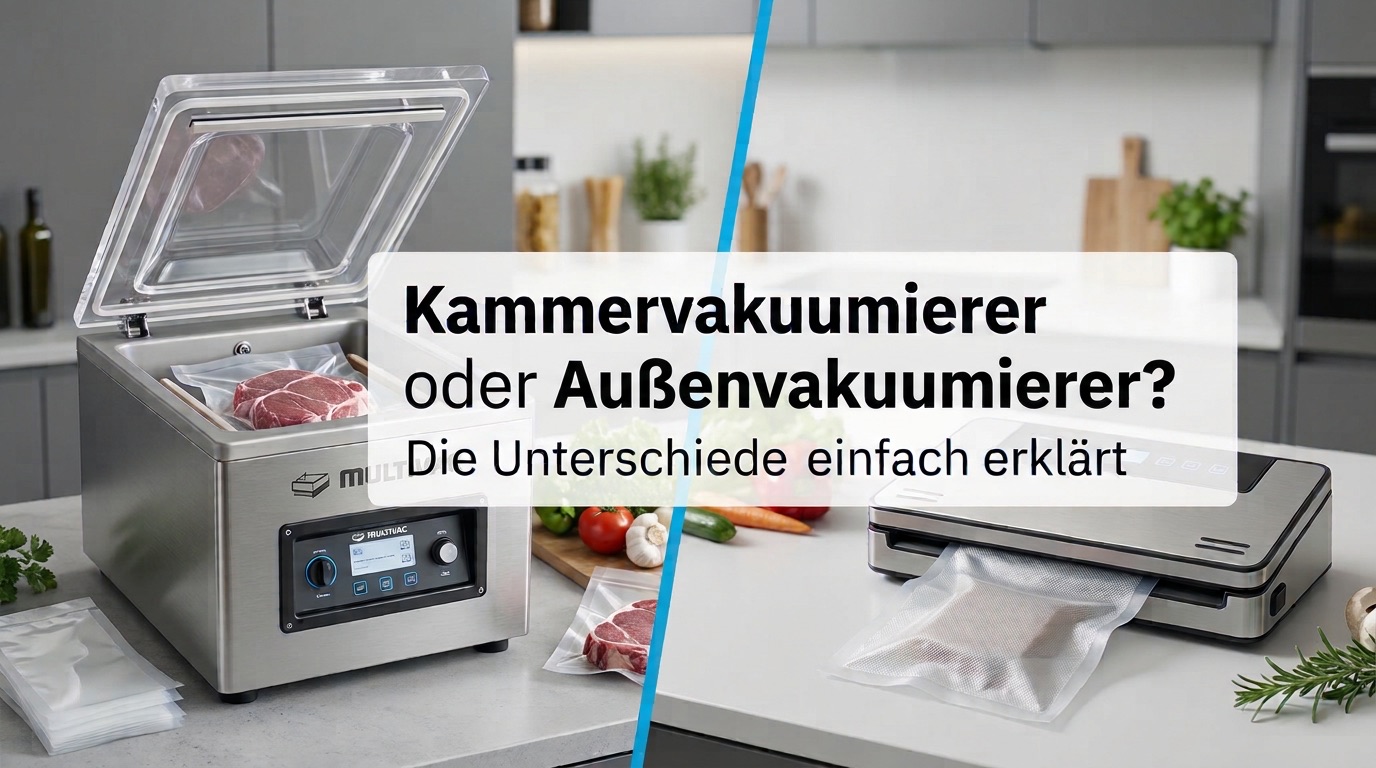
Not every vacuum sealer works the same way. While a classic edge (external) sealer is mainly suited to the home, a chamber sealer offers extra options for liquids, marinades and larger quantities. But which device is really worth it? In this comparison we put both technologies side by side and show what to look for when buying.
1. What is an edge (external) vacuum sealer?
An edge vacuum sealer (also called external or suction sealer) is the classic type found in many homes. It draws the air directly out of a special vacuum bag: the open end of the bag is placed in the device, an integrated pump pulls the air out, and a heating bar then seals the bag airtight.
How does an edge sealer work?
- Place the food in a suitable vacuum bag.
- Insert the open end of the bag into the device.
- The device starts the suction process.
- The air is drawn out through special channels in the bag.
- The heating bar seals the bag.
Advantages of an edge sealer
- Cheaper to buy.
- Compact and space-saving.
- Easy to use.
- Ideal for meat, fish, cheese and dry food.
- Long items can also be packed easily.
- Many devices are compatible with vacuum rolls.
Disadvantages
- Liquids can be drawn towards the device during suction.
- Usually needs special textured or embossed vacuum bags.
- For larger quantities, longer pauses between cycles may be needed.
- Liquid marinades and soups are harder to pack.
2. What is a chamber vacuum sealer?
A chamber vacuum sealer works on a different principle. The entire bag, including its contents, is placed inside a closed chamber. The device reduces the air pressure throughout the whole chamber – so the air is removed both outside and inside the bag. A sealing bar then closes the bag. When air returns to the chamber, the bag wraps tightly around the food.
How does a chamber sealer work?
- Place the food in a suitable vacuum bag.
- Put the whole bag into the vacuum chamber.
- Position the open end over the sealing bar.
- Close the lid.
- The device reduces the air pressure in the chamber.
- The bag is sealed.
- The chamber is refilled with air and the lid can be opened.
Advantages of a chamber sealer
- Ideal for liquids, sauces and marinades.
- Especially suited to meat and fish with liquid.
- Usually needs no textured vacuum bags.
- Smooth vacuum bags are often cheaper.
- Well suited to regular and larger packaging volumes.
- Liquid foods can be sealed directly, provided fill levels and device specifications are observed.
Disadvantages
- Higher purchase price.
- Larger and heavier.
- Needs more space in the kitchen.
- The chamber size limits the possible packaging dimensions.
- Some devices need regular maintenance, e.g. an oil change on oil-lubricated pumps.
3. The main differences at a glance
- How it works: edge → draws air directly from the bag; chamber → evacuates the whole chamber.
- Purchase cost: edge → cheaper; chamber → more expensive.
- Size: edge → compact; chamber → larger.
- Weight: edge → lighter; chamber → heavier.
- Liquids: edge → limited; chamber → very well suited.
- Marinades: edge → harder; chamber → very well suited.
- Bags: edge → embossed/textured; chamber → smooth.
- Bag prices: edge → often higher; chamber → often cheaper.
- Long items: edge → very well suited; chamber → limited by chamber size.
- Large quantities: edge → better for smaller amounts; chamber → good for regular volumes.
- Cleaning: edge → drip tray and seals; chamber → chamber and seals.
- Typical use: edge → home; chamber → catering and demanding households.
The actual properties always depend on the specific model.
4. Which vacuum bags do you need?
An important difference between the two devices is the packaging material required.
Bags for edge sealers
Edge sealers usually need embossed vacuum bags with a textured inner surface and small air channels. These channels let the machine draw the air out of the bag. They are available as pre-made bags or as vacuum rolls.
Bags for chamber sealers
Chamber sealers usually use smooth vacuum bags. Because the whole chamber is evacuated, the bag needs no special air channels. This often makes these bags cheaper and allows economical packaging of larger quantities.
Important: bags must always be suitable for the specific device and intended use. Not every vacuum bag is compatible with every device. More on this in Why are some vacuum bags textured and others smooth?
5. Can both devices seal liquids?
This is where one of the biggest differences shows.
Edge sealers and liquids
With an edge sealer the air is drawn directly out of the bag, and liquid can be pulled towards the suction channel. This can mean:
- Liquid gets into the device.
- The seal doesn't work properly.
- The bag isn't fully closed.
There are ways to reduce the problem, though:
- Freeze liquids before sealing.
- Prepare food with little marinade.
- Use a dedicated marinade function, if the device has one.
- Use the pulse function, where it allows controlled stopping of the suction.
Chamber sealers and liquids
A chamber sealer is far better suited to this. Because the air pressure is reduced throughout the chamber, liquid is usually not pulled towards a suction opening. This allows sealing of, for example:
- Soups and stocks.
- Sauces.
- Marinades.
- Meat with liquid.
- Fish in marinade.
However, the bags must be filled correctly. With too much liquid it can foam up or overflow during sealing.
6. Which is cheaper to run?
The purchase price isn't the only cost factor – the bags matter too. Edge sealers usually need textured bags, while chamber sealers work with smooth ones. Smooth bags are often cheaper, which adds up with regular use.
A simple example – assume a family or small business packs 100 portions per month:
- Example cost per bag: edge sealer €0.15 · chamber sealer €0.06.
- 100 bags per month: edge sealer €15 · chamber sealer €6.
- Cost per year: edge sealer €180 · chamber sealer €72.
All prices are illustrative calculation assumptions, not current market prices.
In this example the difference is €108 per year. However, a chamber sealer usually costs considerably more to buy – so you have to look at total cost. For someone using only ten bags a month, a cheap edge sealer can be more economical. For someone packing larger quantities daily, a chamber sealer can pay off in the long run. (Whether vacuum rolls or pre-made bags are cheaper is something we've worked out separately.)
7. Which device suits which use?
For the normal household
An edge sealer is usually the more sensible choice. It's excellent for:
- Freezing meat and fish.
- Portioning food.
- Storing cheese and cold cuts.
- Protecting dry food.
- Preparing food for sous-vide cooking.
It's cheaper, needs less space and is enough for most everyday tasks.
For ambitious home cooks
A chamber sealer can be interesting if you regularly work with marinades, liquids and larger quantities. It's especially handy for:
- Meat in marinade.
- Homemade sauces.
- Liquid foods.
- Larger amounts of meat for the freezer.
- Regular sous-vide preparation.
For catering and business
A chamber sealer is often the better choice. Restaurants, butchers and catering companies regularly pack larger quantities. Being able to seal liquids directly and use cheaper smooth bags makes daily work easier and reduces running costs.
8. Conclusion: chamber or edge sealer?
Both devices serve the same basic purpose but differ clearly in how they work and what they can do. An edge sealer is the right choice for most households: compact, affordable and ideal for daily portioning and freezing. A chamber sealer offers more when liquids, marinades or larger quantities are packed regularly.
The decision shouldn't depend on price alone, but on how often and for what the device is used.
Our recommendation:
- For occasional use and normal household tasks: edge sealer.
- For regular marinating and sealing liquids: chamber sealer.
- For larger quantities and commercial use: chamber sealer.
The best vacuum sealer is ultimately the one that suits your cooking habits and actual needs. Browse our vacuum sealers, rolls and bags – or get in touch, we are happy to help.
Frequently asked questions (FAQ)
What's the difference between a chamber and an edge sealer?
An edge sealer draws air directly out of the bag. A chamber sealer reduces the air pressure throughout the whole chamber in which the bag sits.
Can an edge sealer seal liquids?
Normal edge sealers struggle with liquids. Special functions or freezing the liquid first can help.
Why are chamber-sealer bags cheaper?
They usually need no special textured inner surface, so simple smooth bags can be used.
Can I use normal vacuum bags in a chamber sealer?
Only if they are explicitly suitable for the device and intended use. Usually smooth chamber bags are used.
Is a chamber sealer better?
Not necessarily. It offers more options but costs more and needs more space. For most households an edge sealer is perfectly sufficient.
Can I marinate meat with a chamber sealer?
Yes. It's especially good for packing meat together with liquid marinades. Practical tips in Vacuum marinating meat.
How long does vacuum-sealed food last?
It depends on the type and freshness of the food, the temperature and storage. Vacuum sealing does not extend shelf life indefinitely and replaces neither refrigeration nor freezing.